Friday, April 26, 2013

Three new border crossings to open


26 Apr 2013

BANDAR SERI BEGAWAN - Thailand and Myanmar have agreed to open three more permanent border checkpoints to give a boost to economic development.
Surapong: Sought help on Rohingya
Prime Minister Yingluck Shinawatra and Myanmar President Thein Sein agreed on the Myanmar-proposed initiative on the sidelines of the 22nd Asean Summit in Brunei which ended on Thursday.
Deputy government spokesman Phakdeeharn Himathongkham said Ms Yingluck thanked the Myanmar government for raising the issue.
The checkpoints are between Thailand's Three Pagodas Pass in Kanchanaburi and Myanmar's Phayatongsu town; Ban Nam Pu Ron in Kanchanaburi and Myanmar's Tiki town; and the Singkorn temporary checkpoint in Prachuap Khiri Khan and Myanmar's Mortong town, he said.
Mr Phakdeeharn said Ms Yingluck told Thein Sein that opening three more checkpoints would help strengthen ties between Thailand and Myanmar.
He said Ms Yingluck took the opportunity during her meeting to follow up an earlier request made by Deputy Prime Minister and Foreign Minister Surapong Tovichakchaikul about Rohingya migrants.
He called for the Myanmar government to send officials to Thailand to investigate the Rohingya migrants being detained here.
Mr Surapong said during the Asean Foreign Ministers Meeting in Brunei this month that he had sought cooperation from his Myanmar counterpart Wunna Maung Lwin to help return about 2,000 detained Rohingya to Myanmar.
Wunna Maung Lwin had pledged to take them back if his officials found they truly came from Myanmar's Rakhine state.
Mr Phakdeeharn said the two leaders also discussed the progress of the Dawei deep-sea port development project after Thailand and Myanmar earlier set up a joint committee to monitor the project.
He said Ms Yingluck told Thein Sein that Thailand had finished drafting a Special Purpose Vehicle (SPV) shareholder agreement.
She said she would like the Myanmar side to consider it.
The agreement sets the environment of shareholder rights and regulations for the management and operational policies of the project.
Mr Phakdeeharn said the two countries agreed they would meet to further discuss finance and investment issues for the project and would invite Japan to join the talks next month.
At the Asean Summit, Ms Yingluck proposed the connectivity of the three Asean pillars - political-security, economic, and socio-cultural communities - through cultural activities and tourism to promote public interaction.
She also wants to push forward assistance in medicine, public health, and education.

Myanmar continues atrocities


The West might need to reconsider economic sanctions
MYANMAR's rulers will need to do better than just release another batch of political prisoners if they want to assuage mounting concern that the international community may have gone too far, too soon in rewarding them for progress towards dismantling dictatorship and establishing democracy.
After the UN concluded that the country's Rohingya Muslims were among the most persecuted minorities on earth, the Human Rights Watch organisation has issued an even more damning report -- a shameful indictment of a regime that the world has tried to help.
The HRW report details ethnic cleansing and crimes against humanity committed by chauvinist Buddhist mobs. It includes footage of police and soldiers standing by idly or joining violence that has left hundreds dead and wounded and 150,000 homeless.


Many Rohingya, who are denied citizenship, are living in appalling conditions. They are seeking to flee in rickety boats, adding to the wave of desperate asylum-seekers in our region.
By failing to end the violence, President Thein Sein's government has breached repeated assurances given to the international community in return for lifting sanctions.
In the case of the EU which, like Australia, has now cancelled all sanctions other than an arms embargo, Myanmar promised to release all political prisoners, end the persecution of the Rohingya and improve their status and welfare.
That hasn't happened. And while the regime has announced the release of another 60 political prisoners, hundreds more remain incarcerated.
It was always naive to be starry-eyed about the Myanmar regime's democratic pretensions. Lifting economic sanctions in return for political reform made sense, but only as long as Mr Sein and his colleagues kept their side of the bargain.
The international community has lost a substantial part of its leverage, but it must maintain its pressure not just on Mr Sein but also on opposition leader and Nobel Peace Prize-winner Aung San Suu Kyi, who has been regrettably mute about the outrages.
Foreign Minister Bob Carr is right to advocate robust discussion about human rights and democracy with the regime. A new order in which abuses such as those against the Rohingya are allowed will be a democracy in name only, little better than the odious dictatorship of the past 50 years.

Myanmar's Rohingya left with little hope


 24 Apr 2013
Al jazeera
Wayne Hay


Thousands of Muslim refugees stuck in squalid camps in Rakhine state, left to wait for government to decide their fate.


Mosques in Rakhine state were destroyed in ethnic violence, Human Rights Watch reported [AFP]
For Muslims displaced by last year's religious violence in western Myanmar, there is no light at the end of the tunnel and the strain is beginning to show.
I have visited the refugee camps on the outskirts of the Rakhine State capital, Sittwe, several times, but this was my first visit in six months and I was struck by several changes, none of them positive.
More than 100,000 people remain homeless after attacks that were at first described as communal clashes. Subsequent violence and burning made it clear, however, that this had been largely an anti-Muslim campaign.
Most of the people in the camps are Rohingya Muslims, an ethnic group largely viewed as illegal immigrants from neighbouring Bangladesh. Their homes were burned down by groups of Buddhists as part of a campaign that Human Rights Watch described as ethnic cleansing.
The only way refugees can leave the camps is by getting on a boat and heading south in the hope of finding a better future in Thailand or Malaysia, but few can afford the bribes that need to be paid along the way. For many Rohingya, there is no choice but to sit and wait for the Myanmar government to decide their fate.
Government promises
The best they can hope for, at the moment, is for is some sort of more permanent housing to be built by the government. Such shelter has been promised for some time, but not delivered.
In my previous visits there had been a lot more fervor in the camps. People surrounded us, wanting to tell us their often-horrific stories. We were asked to spread the word to the international community.
Those feelings and memories haven't gone away, of course, but this time I was left with the sense that the refugees are understandably being worn down. An air of hopelessness is setting in.
People are hungry, but there is plenty of food around. People are dying, even though there is a hospital just down the road. If you were a Muslim caught up in the violence, your freedoms have now been taken away.
Yet, amid the desperation there are incredible stories of people helping their own. I was fortunate to meet Maung Maung Hla, a health worker who for 30 years was employed by the government to provide assistance at hospitals in Rakhine State.
Ten months ago, the government stopped paying him. Why? Because he's Rohingya. Now, he lives and works in the camps providing what medical assistance he can to those who live there.
There is not enough medicine to go around and not enough room for those who need in-patient treatment in his tiny medical centre.
Buddhist doctors make brief visits from the town and very occasionally a seriously ill patient is allowed to be taken to the main Sittwe hospital for treatment and medication. In some cases, much-needed surgery is denied because the patient is a Muslim.
Maung Maung Hla busily moved from one end of the medical centre to the other. He took the blood pressure of pregnant women, checked the cast on a fisherman's broken leg, and provided what little comfort he could to a man who was bitten by a rabid dog and was having regular seizures.
The man will die soon and should be in a proper hospital. He's not, because of his religion.
I asked Maung Maung Hla why he continued to do this work even though the government has cut him off. He broke down and said his people have no one else to turn to.
The people of these camps are not just being let down by the government of Myanmar, but by governments around the world who continue to trip over themselves in the rush to reap the financial rewards on offer in this evolving democracy.

Rakhine IDPs in Myanmar brace for monsoon rains


RAKHINE STATE,  More than 125,000 displaced Rohingya in Myanmar’s western Rakhine State are bracing for this year’s punishing monsoon rains.

“There’s no real shelter here. People are getting diseases and the rainy season will make it even worse,” Ali Mia, a 45-year-old Rohingya father-of-six, whose home in Sittwe, the capital city of Rakhine State, was burned during inter-communal violence in June, told IRIN.

Set to begin as early as May, the rains will come in daily downpours, which, in the crowded and unsanitary conditions of Rakhine’s dozens of camps for internally displaced persons (IDPs), could hasten the spread of disease, aid workers warn.

“We’re very worried with the monsoon season coming up. If these people are not relocated we could see a very big humanitarian problem, [including] disease outbreaks,” said Peter Paule de Groote, the head of Médecins Sans Frontières (MSF) in Myanmar. "The water level will rise and some of it will be very, very muddy, if not flooded, and there’s nowhere for them to go.”

Sectarian clashes between Buddhists and Muslims in June and October left 167 dead, hundreds injured and more than 125,000 displaced in Rakhine State, according to government estimates.

More than 10,000 homes were burned or destroyed in the violence.

Under Burmese law, the Rohingya are de jure stateless. There are an estimated 800,000 Rohingya in Myanmar and human rights groups say they have long faced persecution and discrimination.

On 19 April [ http://reliefweb.int/report/myanmar/monsoon-approaches-fears-rise-displaced-myanmars-rakhine-state ], the UN Refugee Agency (UNHCR) called for urgent action and increased financial support to improve conditions of the displaced to avert a “humanitarian catastrophe”.

Some have camped in paddy fields or low-lying areas that will flood once the rains start.

Already, international aid groups are reporting high cases of respiratory and skin infections, worms and diarrhoea in the camps they have visited. Such diseases are much more likely to spread in sodden conditions, they warn.

Moreover, the onset of rains will likely be accompanied by a spike in water-borne diseases, and the camp’s primitive latrines remain vulnerable to overflowing from rainfall.

“The water and sanitation situation is appalling,” said MSF's de Groote.

Unregistered lack assistance

But it is the risk of those displaced not yet registered with the authorities that is most worrying.

While partners are providing life-saving assistance to more than 100,000 IDPs registered by the government, there is a sizable population (15,000 individuals) that is displaced but has yet to be allowed access to humanitarian aid.

Several thousand are living in makeshift sites that have not been sanctioned by the government. IDPs in these locations receive limited to no assistance as opposed to those in official camps.

Unlike in official camps, where residents are supplied with waterproof tents, residents of Maw Than Mia, home to some 1,000 unregistered displaced, sleep in tiny huts constructed of nothing more than thatched straw.

They are particularly vulnerable because their camp is spread across a low-lying field which, previously used for rice cultivation, is designed to flood.

Aid agencies are calling on the government to address the shelter needs as a matter of priority, noting adequate land needs to be identified and allocated and challenges related to water and sanitation addressed, particularly in Myebon and Pauktaw.

Inter-agency plans

According to the UN Office for the Coordination of Humanitarian Affairs, humanitarian partners, in collaboration with the government, have developed an inter-agency preparedness plan for Rakhine running from March to June.

The plan aims to address preparedness and response actions with specific sector/cluster response plans for two scenarios: 1) a potential natural hazard such as a cyclone which would affect over 250,000 people across the state and 2) a potential deterioration of the humanitarian situation during the rainy season, particularly in the camps.

bb/ds/cb

Thein Sein Receives Peace Prize Amid Ethnic Cleansing Allegations


Thein Sein Receives Peace Prize Amid Ethnic Cleansing Allegations

April 24, 2013
The inquisitr


Myanmar President Thein Sein received a peace prize on Monday despite reports that he participated in, or at least endorsed, ethnic cleansing in the country.
While Myanmar has been celebrated for his quick democratization, not everything is going well for its people. The Rohyngya have steadily attempted to escape from the country amid escalating violence aimed at them.

While more than 200 people were killed in the region, more than 125,000 were made homeless through mass arson, looting, and cold-blooded murder. The fighting erupted between ethnic Rakhine Buddhists and the stateless Muslim Rohingya.A new Human Rights Watch report on Myanmar’s ethnic cleansing of the Rohingya people was released this weekend. The HRW’s report was made on the sectarian violence that struck in Arakan state last year.
The Human Rights Watch accused the Rakhine in the report of instigating the bloodshed. It also implicated state authorities for allowing the group to continue with no resistance. More violence against the ethnic Muslims erupted last month, threatening the country’s stability.
But despite the report from the HRW, the International Crisis Group presented Sein with their “In Pursuit of Peace” award. The ceremony was hosted by ICG President Louise Arbour, who also served as a UN high commissioner for human rights.
Arbour was also a lead prosecutor for the International Criminal Tribunal for the former Yugoslavia and for Rwanda. On its website, the ICG praised Sein, saying:
“Since taking office in March 2011, President U Thein Sein of Myanmar has pioneered a historic transformation of his country with bold reform initiatives. His leadership has seen decisive action towards improving Myanmar’s relations with the political opposition and liberalizing past repressive laws.”
But not everyone in the international community agreed with the ICG’s assessment of Sein. Along with the Human Rights Watch, hacktivist collective Anonymous andseveral others have called for support for the Rohingya. The HRW’s report instead blames some in Sein’s government and Bhuddist monks for carrying out the systematic campaign to cleans Rohingya Muslims from the Rakhine state.
As for Sein’s part in the matter, the Myanmar president stated in July 2012 that the “only solution” to the violence in Rakhine state would be to expel “illegal” Rohingya from the country.
Do you think Thein Sein deserves the peace prize for democracy in Myanmar, or should he instead be investigated for war crimes against the Rohingya?
[Image via Thai Government]

Address ethnic violence: Carr to Myanmar


Foreign Minister Bob Carr
Foreign Minister Bob Carr has asked the leaders of Myanmar to address ethnic and religious violence. Source: AAP

FOREIGN Minister Bob Carr has welcomed the European Union's decision to lift sanctions on Myanmar (Burma), but remains concerned by ethnic violence in the impoverished South-East Asian nation.

EU foreign ministers agreed to lift the last of the bloc's trade, economic and individual sanctions against Myanmar, hailing "a new chapter" with the once pariah state.
During a visit to Brussels in March, Myanmar's president Thein Sein urged the EU to lift sanctions, saying "we are one of the poorest countries in the world".
EU ministers noted there were "still significant challenges to be addressed" around hostilities in Kachin state and improving the plight of the Rohingya people.
Senator Carr, who lobbied EU foreign ministers for the change, said he also wanted Myanmar's government to more effectively address religious and ethnic violence.
"These are deep-seated conflicts and I welcome President Thein Sein's commitment to hold an investigation into recent violence", he said in a statement.

"Promoting and, where necessary, having robust discussions about human rights and democracy in Myanmar will remain a central element of our engagement."
Australia lifted travel and financial sanctions on Myanmar on June last year, but its arms embargo against the nation remains in place.
The EU also upheld its ban on arms trading with the South-East Asian nation.

Rohingyas’ lawyers barred from homicide reenactment


The first punch: A number of Rohingya refugees from Myanmar take part in a reenactment of an incident that occurred on April 5, that left eight Buddhist Myanmar fishermen dead, at the Belawan Immigration Detention Center, North Sumatra. The reenactment took place at the Belawan Port Police precinct. (Antara/Septianda Perdana)


The first punch: A number of Rohingya refugees from Myanmar take part in a reenactment of an incident that occurred on April 5, that left eight Buddhist Myanmar fishermen dead, at the Belawan Immigration Detention Center, North Sumatra. The reenactment took place at the Belawan Port Police precinct. (Antara/Septianda Perdana)


Wed, April 24 2013
Apriadi Gunawan,
The Jakarta Post


The National Police prohibited lawyers representing Myanmar Muslim Rohingya refugees from accompanying their clients during a reenactment of a homicide in Belawan in which eight Buddhist Myanmar citizens were killed on Tuesday.

Members of the legal team from the North Sumatra Legal and Human Rights Advocacy (PAHAM) and the Muslim Lawyers Team (TPM) were turned away by police officers guarding the scene of the reenactment at the Belawan Port Police station, despite the fact that the legal team, led by PAHAM director Dodi Chandra, presented a letter of appointment signed by the suspects.

“We showed the letter of appointment but we were still forced to leave by the police. We were not allowed to represent our clients, who were carrying out the reenactment,” Dodi told The Jakarta Post after failing to meet his clients on Tuesday.

Dodi said they had been waiting for the police’s permission to accompany their clients in the reenactment from 9 a.m. but had been turned away. He said it was a rights violation because every suspect had a right to legal representation.

”What’s wrong with this? Why are the police so secretive in the reenactment involving our clients? We believe the police are hiding something,” said Dodi, who plans to report the matter to the National Police and North Sumatra Police chiefs.

Seventeen refugees who have been named suspects took part in the reenactment, which was heavily guarded. When contacted for confirmation, Belawan Port Police deputy chief Comr. Robertus Pandiangan denied preventing the lawyers from attending the reenactment.

He said only the 17 suspects attended so that they could calmly reenact the events of the April 5 clash.

”We reenacted 27 scenes today [Tuesday] from the clash until after,” Robertus said, adding that the outcome of the reenactment would be submitted to the prosecutor’s office.

He added that based on the reenactment, the clash between the Muslim refugees and the Buddhist fishermen was sparked by sexual harassment of women refugees by the fishermen.

Robertus said the crime was not premeditated.

International Crisis Group Makes A Mockery Of ‘Peace’ In Burma – OpEd

Burma's Thein Sein meets U.S. President Barack Obama in Yangon, 18 November 2012

April 23, 2013


By Francis Wade
At a glitzy dinner tonight in New York, where the cover charge for a table can reach heady six figure sums, Burma’s President Thein Sein will be honoured with the International Crisis Group’s top peace award. Across the pond he will receive additional applause from the EU in the form of a termination of all sanctions on Burma, except for its arms embargo.
Yet away from the pomp of the ICG awards ceremony, a starkly different picture has been painted. Human Rights Watch released a report Monday that wholly implicates Burma’s government in crimes against humanity and ethnic cleansing in Arakan state. This isn’t the conclusion of an investigation into the former junta’s rights record, but instead something very current, and for which Thein Sein bears responsibility.
“The Burmese government and security forces are responsible for attacks on the Rohingya [last year] in which crimes against humanity were committed,” said Matthew Smith, a consultant with HRW. Phil Robertson, deputy Asia director of HRW, said in a statement that the government “engaged in a campaign of ethnic cleansing against the Rohingya that continues today through the denial of aid and restrictions on movement”.
The emphasis of the report, which the group put together using extensive testimonies collected on the ground in Arakan state, is official complicity in the displacement of 125,000 Rohingya, and the deaths of hundreds. The intended end result of this campaign of violence, which has involved local politicians, NGOs and security forces, as well as civilians, is the removal of an entire ethnic group, either through death or displacement.
To date, the government has denied any responsibility for the two major waves of violence in June and October last year. It said in response to HRW’s accusations of complicity by security forces that the claims were “unfounded and not true information … [security forces] took security measures day and night without taking sides and without discrimination of race and religion”.
Eyewitnesses in Arakan state tell otherwise – police, army and the NaSaKa border security group were directly involved in razing houses and escorting violent mobs of Arakanese into Rohingya areas. In Yan Thei village in Mrauk U, police “assisted the killings by disarming the Rohingya of their sticks and other rudimentary weapons they carried to defend themselves,” HRW said. It also details an incident in which a government truck dumped 18 Rohingya bodies outside a Rohingya camp, a practice that is consistent with the campaign of intimidation that is often an ingredient in ethnic cleansing.
Over in Meiktila in central Burma, where entire Muslim quarters were razed by Buddhist mobs last month, footage has just emerged that shows police watching as Muslim-owned properties are destroyed.
In this context then, one struggles to fathom how ICG could honour Burma’s president. To be sure, Thein Sein has overseen positive developments in several spheres, such as media and opposition political participation. Yet this award is about peace, an area in which he has failed disastrously. “International Crisis Group’s goal is as ambitious as it is vital: to mobilise leaders around the globe to prevent and end deadly conflict,” the statement introducing the award says.
But since Thein Sein came to office, civil war has broken out in Kachin state, fierce rioting has erupted in Arakan state, and several waves of deadly anti-Muslim violence have rocked central Burma, while a huge increase in internal displacement of civilians has occurred, as has unprecedented refugee flows from western Burma to other Southeast Asian countries. The list goes on. He has demonstrably failed to respond to evidence that prominent parliamentarians, such as Dr. Aye Maung from the Rakhine Nationalities Development Party, have called for the removal of the Rohingya; indeed last year Thein Sein asked the UN to resettle all 800,000 Rohingya. In ICG’s own words, however, the man should be applauded for his “efforts to bring us closer to a world free of conflict”.
The EU’s decision to drop sanctions is also highly contentious, and for similar reasons, yet it has maintained an arms embargo precisely because of substantial ongoing concerns about the military, which has shown no sign that it intends to mend its ways. ICG, which pins the award to positive developments towards an end to armed conflict, appears to refute those concerns.
The award is especially galling for Burma because ICG has backed a war crimes investigation into the Sri Lankan conflict. ICG is undoubtedly aware of what has occurred in Burma in the two years since Thein Sein became president – it follows the developments there closely, but is evidently guilty of sidelining the negatives and myopically homing in on the positives, despite the scales currently tipping in favour of the former.
It’s hard to tell why exactly they’ve chosen such a controversial position on Burma. Burmese academic Maung Zarni has some very useful thoughts here, while past observers have talked of groups like ICG wanting to become part of a “pacted transition” in Burma, with a pro-trade and aid stance that ultimately reaps significant economic benefits for stakeholders, ICG included. This commentary accuses them of being “democracy manipulators” headed by men and women with key ties to the US elite who would have considerable personal interests in a Burma that is open to business. Either way, one would be wise to take the award with more than a pinch of salt – it’s woefully misguided, and carries the potential to induce a dangerous naivety among those not versed in the major pitfalls of this transition.

Tuesday, April 23, 2013

Stand with Rohingya till find a solution: Dipu Moni


Chittagong, Bangladesh: “We must send out a clear message to our Muslim brethren in Burma that we shall continue to stand by them and never give up till we find a lasting solution to their problems is found,” called at the Organization of Islamic Cooperation – OIC - contact group meeting at its headquarters in Jeddah on April 14 by Bangladesh Foreign Minister Dipu Moni.

Bangladesh Foreign Minister Dipu Moni

“We must continue to act as a conduit to channel their legitimate concerns to the larger international audience.”
“We must recognize and use the strength of our moral weight to make sure that the most vulnerable people in Burma, especially the Rohingyas, do not remain excluded from the dividends of reform,” Dipu said.
Dhaka urged the Burmese authorities to ensure that the minorities – Rohingya- get back their nationality rights and live as Burmese citizens in safety and with dignity, according to a Foreign Ministry statement released on April 15.
“The issue of safe and sustainable return of Rohingya refugees from Bangladesh to Burma as well as the large number of Rohingya Muslims in an irregular situation also remains an outstanding concern for Bangladesh.”
The current official attempt in Burma to term Rohingyas “Bengali or Bangladeshi immigrants” in a general sweep does not have any historical or legal basis, the Foreign Minister said.
“The international community must encourage the Burmese government to promote dialogues between the Muslims and Buddhists in the Arakan state and other sectarian flashpoints, the Foreign Minister called.
The foreign minister stressed the need for neutralizing the radical elements within both the communities and for promoting dialogue among the moderates within their respective leaderships.
“OIC could possibly offer to play the role of a facilitator for holding inter-communal and inter-faith dialogues to reinforce mutual respect and understanding. The festering tension between the two communities has already started having bitter implications beyond the borders of Myanmar.”
“Within the OIC, we must rise to the occasion and get things done to end the systematic persecution and discrimination against the Rohingyas and other Muslim minorities in Burma.”
“OIC urged authorities in Burma to allow a ministerial OIC delegation to visit the country to discuss deadly violence against Muslims,” stated on April 14, at Jeddah, Saudi Arabia at a meeting of Burma contact group comprised of foreign ministers of the OIC and also urged the UN Human Rights Commission to dispatch a fact-finding mission to Burma.
 
OIC chief Ekmeleddin Ihsanoglu
"Such violence is a clear indication of the government's negative approach in dealing with ethnic and religious tensions that erupted last summer," said OIC chief Ekmeleddin Ihsanoglu, describing the violence as "unacceptable".
While the Rohingya -- described by the UN as among the most-persecuted minorities on the planet -- have long been denied Burmese citizenship.
Last year the OIC condemned the violence against Muslims - Rohingya - in Burma as "genocide".
“Attacks on Burmese Muslims are highly planned and coordinated and security forces do not stop the incidents,” Turkish Foreign Minister Ahmet Davutoglu told at Saudi Arabia meeting of a Myanmar contact group comprised of foreign ministers of the OIC.

Turkish Foreign Minister Ahmet Davutoglu
“Burmese’s government must show that perpetrators of such kind of incidents cannot go unpunished. Hatred between Muslims and Buddhists must be averted,” he said.
“More than 100 thousand people had to leave their homes and they still did not return to their home. Moreover they are denied of their rights.”
Davutoglu said Turkey was ready to extend any support to OIC.

A Sad State of Affairs as Asean AWOL Over Rohingya Issue


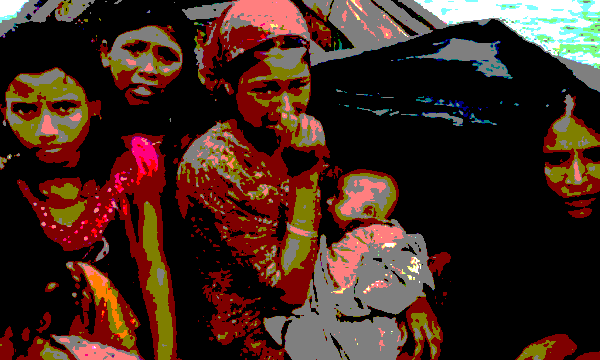
A Rohingya Muslim family in Pawtauk Township, Arakan State. (Photo: JPaing / The Irrawaddy)
RANGOON — According to Burma’s government, the Rohingya do not exist. Denied citizenship by an internationally criticized 1982 law, the stateless “Bengali immigrants” have in the past faced pogroms, persecution from the Burmese government and more recently from other Burmese.
Thousands of Rohingya have fled to countries such as Bangladesh, Indonesia, Malaysia and Thailand over the past year, giving Burma’s neighbors and the Association of Southeast Asian Nations (Asean) an ostensible stake in addressing the Rohingya crisis.

But despite launching a new human rights body at the most recent Asean summit in Phnom Penh in November 2012—including a surprise clause acknowledging “universal” human rights norms—the group has largely stuck to its non-interference mantra.
Since June 2012, over 220 people have died in what has widely been described as sectarian fighting between Buddhists and Muslims in Burma, with most of the deaths in Arakan State in the country’s west, where most of Burma’s estimated 800,000 Rohingya live.

In Arakan State last June, mobs of Buddhists and Muslim Rohingya clashed after the May rape and murder of a young Arakanese woman, a crime for which three Rohingya men were arrested. Arakanese retaliation quickly spread to Myanmar’s other Muslim groups, with ten pilgrims lynched by a Buddhist Arakanese mob in June—a crime for which nobody has been charged.
There were more Arakanese-Muslim clashes in October 2012, and in March this year, 43 were killed—some gruesomely and most of them Muslims—in central Burma, after which the sole arrests, to date, have been 3 Muslims who were involved in a shop row at the outset of the violence.
What at first looked like local sectarian fighting later took on the form of a vicious anti-Rohingya and then anti-Muslim campaign, with rabble-rousing monk Wirathu at the forefront. Burma’s current government has not only not done enough to prevent or stop the violence; it has been complicit, according to some.
The Rohingya say that they have lived in what is now Burma for generations. The Burmese government says they are illegal immigrants. Many Burmese, including senior members of the long-feted opposition National League for Democracy, men who themselves spent years in jail as political prisoners, also regard the Rohingya as illegal immigrants.

Asked last October whether the Rohingya should be granted Burmese citizenship, Tin Oo, a senior NLD figure, said that “those who are not legal citizens of this country cannot stay,” adding that it was difficult to establish how many Rohingya could be entitled to Burmese citizenship.
“This is a difficult problem to solve,” he said. “When I was a young man, there were no Rohingya in Burma.”
Tin Oo’s party colleague, the opposition leader Aung San Suu Kyi, has been criticized for her apparent reluctance to discuss anti-Muslim violence in Burma.

Breaking this silence in Japan last week, Suu Kyi called for a revision of the citizenship laws.
“There is discrimination among citizens in our country,” she said. “We should also determine if certain laws are a hindrance to equal rights among citizens in the country, and revise them if we can.”
Mentioning a meeting she had recently with Burmese Muslim leaders, she lamented the state of inter-faith relations in Burma, saying that “this is a very sad state of affairs. We must learn to accommodate those with different views from ours.”

There has been scant regional pressure on Burma to treat the Rohingya in a more humane way. Asean’s two biggest Muslim-majority member-states—Indonesia and Malaysia—have raised the Rohingya issue with the Burmese government and have sent diplomatic and humanitarian missions to Burma and to Arakan State. But they have for the most part shied away from blunt public condemnation, as is often the way in dealings between Asean countries.
However, the bloc as a whole has been reluctant to single out Burma. Speaking at the most recent summit in Phnom Penh last November, then-Asean Secretary General Surin Pitsuwan said that member states told the Burma delegation that “if the issue is not handled by the Myanmar government, there is a risk of radicalization and extremism in that region.”
Speaking on the sidelines of the Asia-Europe Meeting (ASEM) in Vientiane on Nov. 6, a spokesman for Malaysian Prime Minister Najib Razak expressed unease about the plight of Muslims in western Burma.
“Malaysia remains extremely concerned about ongoing tensions between Buddhists and Rohingya Muslims in the Rakhine State of Myanmar,” he said.
For the most part, that is as far as Asean or its member states have gone in public, with the one exception being Indonesia. Foreign Minister Marty Natelagawa told The Irrawaddy at the ASEM summit that “one core issue in resolving the conflict is citizenship, and this is a matter the Myanmar government must address in the future.”

However, Burmese President Thein Sein told the Democratic Voice of Burma recently that the law would not be changed.
If they were of a mind to, the Burmese government could issue some sharp “heal thyself” type retorts to Jakarta or Putrajaya, in any case. Indonesia has been accused of letting anti-Christian and anti-Ahmadi sentiment get out of hand. Malaysia’s governing parties have dabbled in some sectarian brinkmanship in the run-up to the May 5 election. Hardliners linked to the government threatened to burn Bibles in an unwitting parody of the Rev. Terry Jones, that Perkasa, the group involved, said was in response to a row over whether Malaysia’s Christians should be allowed use the word “Allah” in their literature.
The Organization of the Islamic Conference (OIC) has been much more assertive than Asean with Burma over attacks on the Rohingya, which the OIC deems “genocide.”
Both Indonesia and Malaysia are part of an the OIC’s 11 country “Contact Group,” which has pushed Burma for greater humanitarian access to the roughly 100,000 Rohingya stuck in fetid camps in Arakan State.
The other nine members of the group are Afghanistan, Saudi Arabia, Bangladesh, Brunei, Djibouti, Egypt, United Arab Emirates, Sudan and Turkey, some of which have a torrid history of human rights abuses directed at ethnic and religious minorities.
Burma will, for the first time, chair Asean in 2014, another factor that will likely restrain the bloc’s members from tackling the Rohingya issue head on. Burma had to forego its turn as chair in the past, as Asean feared this would affect the groups’ relations with Western countries.

Next year will be a crucial one for Asean, the final year before it is scheduled to form a regional economic community, and arrangements for Burma’s role as Asean chair will likely take precedence over political or human rights concerns.
In late March, a United States-Asean meeting, looking ahead to Burma’s chairing of the association, gave the Burmese government every encouragement possible.
US Ambassador to Asean David L. Carden said: “I have every confidence Myanmar will be a leading contributor to Asean integration, including economic integration. We are pleased to see the government and private sector are focused on the road ahead and that other Asean member states are showing strong support.”

Myanmar's 'crimes against humanity'


April 23, 2013
Al Jazeera(Inside Story)


We discuss a Human Rights Watch report that alleges government involvement in the violence against minority Rohingya.

Authorities in Myanmar stand accused of a campaign of ethnic cleansing of minority Rohingya Muslims.
According to a report by Human Rights Watch, their actions amount to crimes against humanity, including murder, persecution and deportation. 
It relates to violence in Myanmar's western Rakhine state in June and October of last year, in which more than 200 people were killed, and over 100,000 displaced. 
Human Rights Watch says government security forces did nothing to stop the violence, and even took part in it. 
The report comes as the European Union lifts sanctions against the country and President Thein Sein is given a peace award - the 'In Pursuit of Peace Award' is from the International Crisis Group (ICG). 
The award recognises individuals for their outstanding contributions to the advancement of peace and security and praises the Myanmar's president for his efforts to "bring us closer to a world free of conflict". 
It found extensive state involvement and planning in the killings and destruction of property and that community leaders and Buddhist monks, also played a role in the killings, along with police and army personnel.
The report also criticised Thein Sein's government for failing to bring those responsible to justice. 
Myanmar's government has denied the charges made in the report, and plans to publish its own findings. 
The UN has described the Rohingya as one of the most persecuted minorities in the world. 
Some historians say the group dates back centuries. And many Rohingya in Myanmar migrated from Bangladesh in the early 19th century - that was when Britain annexed Myanmar as a province of British India and brought over migrant Muslim labourers.
The UN estimates they number around 800,000. Most live in Myanmar's western Rakhine state, near the border with Bangladesh. But Myanmar's government does not recognise them as one of the nation's ethnic groups, and denies them citizenship. 
To discuss the findings of the report, Inside Story's Ghida Fakhry is joined by guests: Maung Zarni, a visiting fellow at the London School of Economics, and founding member of the Free Burma Coalition; Alistair Cook, a visiting research fellow at the East Asian Institute of the National University of Singapore; and Mike Harris from the Index on Censorship, an international organisation that promotes and defends the right to freedom of expression. 
"Is he (Thein Sein) deserving of this award? Well firstly, it is obviously not for peace that has already been achieved but it is for peace that could be achieved. What we are seeing with the release of this report or even what is happening in Kachin state or indeed some of the other ethic nationality areas as well - is that there is conflict still ongoing. At the moment the signs aren't there but the motivation ICG have for this award is positive reinforcement." 
Alistair Cook, research fellow at the University of Singapore's East Asian Institute 

Indonesian president urges Myanmar to address Muslim violence


Indonesia's President Susilo Bambang Yudhoyono talks at a Reuters Newsmaker event in Singapore April 23, 2013. Credit: Reuters/Edgar Su
April 23, 2013
Jason Szep and John O'Callaghan


The president of Indonesia, the world's most populous Muslim country, said on Tuesday he would urge Myanmar's leaders to address Buddhist-led violence against Muslims that he said could cause problems for Muslims elsewhere in the region. 
Susilo Bambang Yudhoyono's visit to Myanmar on Tuesday and Wednesday comes a month after at least 43 people, mostly Muslims, were killed in four days of violence led by Buddhist mobs in the central city of Meikhtila, 80 miles (130 km) north of the capital, Naypyitaw. That sparked a wave of anti-Muslim violence
"If it's not addressed in the best way possible, its impact is not good for Myanmar and even for Indonesians who are majority Muslims," Yudhoyono told a Thomson Reuters Newsmaker event, a forum held in Singapore.
Calm has been restored in Meikhtila and other volatile central areas after authorities imposed martial law and dispatched troops. A Reuters examination showed it was well organised, abetted at times by police turning a blind eye.
"I will encourage that Myanmar will address it wisely, appropriately and prevent tension and violence. We in Indonesia are ready to support them to reach those goals," he said.
Yudhoyono will meet with Myanmar President Thein Sein during the visit and sign a memorandum of understanding on rice trade, an Indonesian government official said.
His visit also follows deadly unrest last year against Muslim Rohingya, an ethnic minority, in western Rakhine State which Human Rights Watch, a New York-based rights watchdog, described in a report on Monday as ethnic cleansing -- a charge rejected by the government.
"There are other challenges in Myanmar like communal tensions facing the ethnic Rohingya," Yudhoyono said.
Last year's violence in Rakhine State killed at least 110 people, mostly Rohingya Muslims, and left 120,000 homeless.
Rohingya activists claim their historical lineage in Rakhine dates back centuries, but Myanmar's government regards the estimated 800,000 Muslim Rohingyas as illegal immigrants from Bangladesh and denies them citizenship. Bangladesh has refused to grant Rohingyas refugee status since 1992.
The violence has sparked an exodus of thousands of Rohingya fleeing Rakhine State by boat. Many have ended up in other Southeast Asian countries including Indonesia, where Buddhist and Rohingya Muslims clashed in an overcrowded immigration detention centre last month.
Yudhoyono said Indonesia has a long history of engaging with Myanmar's leaders dating to military rule "to encourage them to continue their process of democratisation so they didn't need to be hurt by embargoes".
The European Union on Monday lifted sanctions imposed in response to human rights abuses during nearly five decades of military rule that ended in March 2011. The country, also known as Burma, has since embarked on a series of democratic reforms.
"World leaders now are visiting Myanmar because they see Myanmar has changed," he said. "I will visit Myanmar today firstly to support and promote the process of democratisation, of nation-building, of the rule of law, human rights."
(Editing by Neil Fullick)

The Monks Who Hate Muslims


April 22, 2013
Francis Wade


Buddhist monks have been major instigators of the recent violence against Muslims in Burma.
In a small wooden office in the Mahamyaing monastery, Kyaw Linn rifles through a carrier bag of stickers emblazoned with 969, the logo that has come to represent Burma's budding anti-Muslim movement. Six months ago the head monk, Oo Wi Ma La, ordered the first batch of stickers from a nearby printing company. Now they're hard to avoid. Taxis, buses, and shop fronts across Rangoon and other major towns now display what some observers consider a symbol of Buddhist extremism -- a symbol that sees Burma's Muslim community as a threat to the country and its dominant religion.
This sentiment has unleashed waves of violence over the past several months that have left more than 40 dead, and 13,000 displaced in 2013 alone. The monastery in Moulmein, southern Burma, is credited as the birthplace of the resurgent 969 movement. Production of the 969 stickers began following rioting in western Burma last year that pitted Buddhists against Rohingya Muslims. The number signifies the attributes of Buddha and his teachings, and is sacred to Buddhists.
"We did it to protect Buddhism," Oo Wi Ma La says, adding that last year's violence in Arakan state made it clear that Buddhism in Burma is under threat. "In Indonesia, Bangladesh, Pakistan, Malaysia, and so on there used to be so many Buddhists, but the Muslims came and kicked them out, and now they are Muslim countries. So based on history we worry Burma could become like that. "
Around four percent of Burma's population practices Islam. It is where the two religions coexist that problems have emerged, says Oo Wi Ma La. In Moulemin's busy and cramped indoor market, however, Muslim stallholders appear calm despite the wealth of 969 stickers increasingly on display on neighboring stalls. Buddhist taxi drivers and shop owners said they have no problem with Muslims using their services.
Unfortunately, however, not everyone thinks the same way. Last month simmering animosity burst into the open once again. A brawl between Buddhists and Muslims in a gold shop in the central Burmese town of Meiktila triggered two days of violence, during which more than 800 homes in the town, mostly Muslim, were razed. Witnesses say that the Buddhist mobs who perpetrated the violence were well-organized, and that the police stood by and watched as killings were carried out in broad daylight. Such reports have led to accusations of official complicity in the violence. Suspicion is prompted by belief that elements within the government or military view communal unrest as a cue for the reinvigoration of a military whose overarching power in Burma is threatened by reforms. A Human Rights Watch report released today directly implicates "political and religious leaders in Arakan State" in the planning, organization, and incitement of attacks against the Rohingya and other Muslims last October. (The report, which focuses on last year's bloodshed in Arakan, notes that the violence there has resulted in the forcible displacement of some 125,000 Arakan Muslims from their homes.)
Yet even if the military-led government may have helped to ignite the Arakan and Meiktila conflicts, the fuel, in the form of anti-Muslim sentiment among Burmese, has been stored up over decades, born of propaganda campaigns in the 1960s that triggered pogroms against Indian Muslims, and later the Rohingya in Arakan state, and the historic conflation of Buddhism with Burmese nationalism.
That movement has seen a resurgence since the Arakan rioting last year whipped up anti-Muslim fervor across Burma. The situation in Meiktila appears to lend weight to claims by some observers that an ethnic cleansing campaign is underway in parts of the country. There, the town's once sizeable Muslim population has been driven into camps which journalists are barred from entering; a similar campaign of cleansing has occurred in Sittwe in Arakan state.
Most narratives of the violence have painted the 969 movement as a cohesive anti-Muslim front that seeks to purge Burma of what it considers a pernicious Islamic presence. Anti-violence protests have used 969 as a symbol to rally against (as shown above). Yet the diverging opinions of those who distribute and carry the symbol shows that this is not so clear-cut. At one end of the spectrum are those who see it more as an identifier of Buddhist solidarity, as Christians display crucifixes. Many say the adoption of 969 as the movement's symbol was done to counter 786, a numerologically important symbol to Muslims that is also seen on some shop fronts. "Now our Buddhist people are trying to give life to this 969 concept, and it saddens me," says U Gambira, a former monk who spent four years in jail for his lead role in the 2007 Saffron Revolution. "They are basically copying something they hate."
Extremists are trying legitimize an objectionable philosophy by drawing on the spiritual "goodness" of what 969 represents: the nine attributes of Buddha, the six attributes of his teachings, and the nine attributes of the Sangha, the religious council that administers Buddhist institutions in Burma. This inevitably gives the movement an immediate appeal among Buddhists, and its leaders can then exploit underlying anti-Muslim sentiment to garner supporters, witting or unwitting.
Carrying the flag for this movement is U Wirathu, head abbot of the Masoyein monastery in Mandalay. Known in the past as a key organizing hub for anti-junta activities, the monastery has more recently developed notoriety following U Wirathu's vitriolic speeches directed at Muslims. Though he acknowledges the possibility of complicity in the recent violence with the military, whom in the past he has fiercely resisted, he considers Islam to be the greater threat. Wirathu chose to be interviewed in front of a wall decked out with self-portraits, a background that made him look more like a cult leader than a humble monk. "According to my research, 100 percent of rape cases in Burma are by Muslims. None are by Buddhists," he claims. "They forcibly take young Buddhist girls as their wives. If the wives continue to practice Buddhism then they torture them every day."
Wirathu is a man of contradictions. His recipe for ending violence and religious tension in Burma is to rid the country of "bad Muslims," but fails to acknowledge that such messages have been a key source of the violence. "If everyone in Burma was like me then there would be peace," he continues, before later handing over a booklet on whose front cover is drawn a lion baring its teeth at a child. The child is a Buddhist and the lion a Muslim, he explains.
U Wirathu was jailed in 2003 for inciting anti-Muslim unrest (though he denies any responsibility for the recent violence). But the government's unwillingness to take action this time round has added to the feeling that elements within the government or military could benefit from the spoils that may result from a fractured Burma.
The geographical reach of the campaign goes beyond just areas with a high Muslim presence. In the Shan state town of Namkham last month, anti-Muslim posters began appearing on lampposts, even though only several hundred Muslims live among the population of 100,000. Locals there, who have resisted a lucrative China-backed oil and gas pipeline that passes close by, have questioned whether the sudden threat of religious unrest in a town where the two religions had coexisted peacefully could be used as a pretext by authorities to crack down on anti-pipeline activities.
This then appears to be a campaign that benefits two powerful forces in Burma: ultra-nationalist civilian groups and hard-line elements in the government and military. If both are strengthened as a result, this will have far-reaching repercussions for the development of democracy in Burma.
Francis Wade is a freelance journalist and analyst covering Burma and south-east Asia.

Burma Accused of ‘Ethnic Cleansing’ of Rohingya Muslims


A Burmese man stands next to his destroyed home in Meiktila, Burma, on April 5, 2012 (Photo: Paula Bronstein/Getty Images)
April 23, 2013
Charlie Campbell

Burma’s quasi-civilian government has been hit by allegations of “ethnic cleansing” and “crimes against humanity” this week as Human Rights Watch (HRW) released its report into the sectarian violence that ravaged the country’s eastern Arakan state last year. At least 200 people were killed and more than 125,000 made homeless as mass arson, looting and cold-blooded murder erupted between ethnic Rakhine Buddhists and stateless Muslim Rohingya. HRW accuses Rakhine groups of instigating the bloodshed and the state authorities of allowing them to continue unabated. Fresh and seemingly unconnected Muslim-Buddhist violence then hit elsewhere last month, posing serious questions regarding the state’s ability — or willingness — to maintain order as the country emerges from half a century of brutal junta rule. The report was released the same day that the country’s President, Thein Sein, was awarded a peace prize by the International Crisis Group, and the E.U. lifted trade, economic and individual sanctions on Burma. 
According to HRW, Rakhine mobs attacked Muslim communities in four townships in June and then nine townships in October, razing villages and burying “hog-tied” corpses in mass graves. The 153-page report details how at least 70 Rohingya were killed in a single daylong massacre in Yan Thei village in Mrauk-U township. “First the soldiers told us, ‘Do not do anything, we will protect you, we will save you,’ so we trusted them,” a 25-year-old survivor told HRW. “But later they broke that promise. The Arakanese beat and killed us very easily. The security did not protect us from them.”
The Rohingya are a stateless people numbering around 800,000, primarily in western Burma. Although many have lived inside the country for generations, they are not included on the list of 135 official ethnic groups as set out by xenophobic former dictator General Ne Win in the 1982 Citizenship Law. The government’s official position is that the Rohingya are illegal Bengali immigrants from neighboring Bangladesh who exploit the porous 300-km border to steal scarce land. They face severe restrictions on travel, marriage and reproduction, and Bangladesh similarly shuns them. Scaremongering Buddhist propaganda also accuses the Rohingya of raping Buddhist women and trying to “Islamify” Burma, now officially known as Myanmar, by taking multiple wives to sire scores of Muslim children. 
Phil Robertson, deputy Asia director at HRW, accused the Burmese government of engaging “in a campaign of ethnic cleansing against the Rohingya that continues today through the denial of aid and restrictions on movement.” The new report details how government authorities destroyed mosques, conducted violent mass arrests and blocked aid to displaced Muslims following last year’s strife. The initial clashes were sparked by the rape and murder of a young Buddhist woman, allegedly by three Muslim men, and then the mob slaughter of 10 Muslim pilgrims on a bus in retaliation. HRW alleges that during the following months, “Buddhist monks, political-party operatives and government officials organized themselves to permanently change the ethnic demographics of the state” by removing every trace of the Rohingya. “They have their strategy, and they have done all these things as a planned, well-designed operation,” says Kyaw Myint, president of the National Democratic Party for Human Rights, a Rohingya political group, and a former political prisoner.
NGOs warn that conditions in the displacement camps are atrocious, with disease rampant and scarce supplies dwindling. This squalor has played no small part in forcing several thousand Rohingya to risk their lives by undertaking the perilous voyage in rickety craft to resettle in third countries, particularly Malaysia. Rohingya must pay the equivalent of $350 for the privilege, of which most goes to Rakhine human traffickers — ironically the same people they are fleeing. Nay San Lwin, a Rohingya activist now living in Germany, lost eight family members in the June violence and tells TIME that he is “100% sure” that the government is behind the killing. “If [the government] had the will to, they could stop [the violence] immediately,” he says. “If they continue like this, you will not find any Rohingya inside the country in five years’ time.” 
Humanitarian groups that help the Rohingya are also under threat. The U.N. High Commissioner for Refugees and Doctors Without Borders (MSF) both had staff detained by the authorities in Arakan state last year, and MSF general director Arjan Hehenkamp told a press conference in February that his organization was being intimidated by the Rakhine for working in Rohingya camps. “In pamphlets, letters and Facebook postings, [MSF] and others have been repeatedly accused of having a pro-Rohingya bias by some members of the Rakhine community. It is this intimidation, rather than formal permission for access [to the camps], that is the primary challenge,” he said in a statement.
Increasingly, the violence has not been limited to Rohingya Muslims. In the wake of last year’s violence, the Kaman, a distinct Muslim ethnic group, was also targeted. And last month, a wave of rioting hit the town of Meiktila, around 500 km north of Rangoon. Clashes were sparked by a seemingly innocuous dispute at a Muslim-owned gold shop, yet soon spread across the region with 43 people killed, at least 800 homes and five mosques torched, plus around 12,000 people sent to ramshackle displacement camps. The violence spread to a further 11 townships, all tellingly without any Rohingya populations. A shocking new video released by the BBC shows Burmese police officers standing idly by while Buddhist mobs ransack Muslim-owned buildings, and saffron-clad monks participating in the bloodshed. It should be noted, however, that many Buddhists put their lives on the line to protect Muslim neighbors and hide them from the rampaging mobs. 
A militant Buddhist organization known by the symbol 969 seems to be at the heart of this resurgent religious animosity, with outspoken monk Wirathu at the helm. Based in Mandalay’s Masoyein Monastery, his bizarre and baseless accusations that Muslims are “waging a jihad war on the Rakhine,” “doping young children with drugs to make them fight” and “disguising themselves as women to get involved in fights” have taken hold. Now 969 stickers are common to denote Buddhist businesses around the country. 
The domestic Burmese media has not helped the situation. The derogatory term kalar — used for any dark-skinned person of South Asian appearance — has appeared in print frequently, as has the term Bengalis, which gives credence to the specious notion that the Rohingya are in fact illegal immigrants. But the strongest criticism has been reserved for Aung San Suu Kyi, the Nobel Peace Prize winner and former political prisoner, who has steadfastly refused to condemn the appalling treatment of the Rohingya, preferring instead to blame a lack of “rule of law.” The former human-rights champion appears unwilling to alienate her Buddhist support base in preparation for the looming general election in 2015. For Burma’s Muslims, that date looks very far off.

Analysis: Myanmar's conflicting narratives


Al Jazeera


Human rights report denounces ethnic cleansing of Rohingya as the West congratulates Myanmar on democratic reforms.
On the same day that his government is accused of ethnic cleansing and crimes against humanity, Myanmar President Thein Sein is being honoured at a fund-raising gala dinner in Manhattan, New York. 
VIPs have paid as much as $100,000 a table for the event "In Pursuit of Peace", which was organised by the International Crisis Group think-tank, which receives some congressional funding. US President Barack Obama won't be there, which is probably just as well, given that Human Right Watch's new 153-page report is likely to cast a dark shadow over the proceedings. 
According to the report by the New York-based rights group, ethnic cleansing and crimes against humanity have been committed against Myanmar's Muslim Rohingya people.
More than 125,000 ethnic Rohingya have been forcibly displaced since two waves of violence in May and October 2012 between the ethnic minority and Buddhist Rakhines left at least 110 dead.
Myanmar's government has done nothing to prevent the violence, alleges the report, and at times government forces are believed to have joined in the attacks on the Rohingya.
The report, released today, comes on the day the European Union plans to lift all remaining sanctions against the country formerly known as Burma.
Two narratives
HRW's accusations come as a sharp rebuttal to the governments and groups that have hailed Myanmar's "golden promise", a phrase that has frequently been used to describe the country's potential if its much touted political and economic reforms continue.
That a positive narrative of Myanmar's current situation can co-exist with the current violence is frightening, according to analysts, because of what some see as the state's "seething hatred" against Muslims. They say the possible regional implications of anti-Muslim violence have so far been ignored by regional powers, and that the geo-strategically important position Myanmar has could cause the violence to continue without foreign action. 
Most Rohingya who live in Myanmar's western Rakhine state are denied citizenship by the Myanmar government, which claims they are illegal immigrants from neighbouring Bangladesh. 
"The government perspective, which is unfortunately also the public's perspective, is that the country's western gate has been broken, the invaders are already here. That's why there's such overwhelming support for the ethnic cleansing of the Rohingya," Dr Maung Zarni, a visiting fellow at the London School of Economics and exiled activist, told Al Jazeera. 
The author of the Human Rights Watch report, Matthew Smith, also spoke of the "very high level of risk" of a third wave of anti-Muslim violence similar to those witnessed in May and October 2012. 
Dr Thitinan Pongsudirak of Chulalongkorn University said great measures needed to be taken if violence were to be curbed. "Leadership has to be very bold and willing to take some risks," he said. "Thein Sein and Aung San Suu Kyi should put aside election prospects and utilise whatever resources they have. Short of that, we will see more violence."
Aung San Suu Kyi's failure to take up the case for the Rohingya in public is probably the most obvious example of the limits of her role. 
There's little doubt that if an election were held today she would win, but, in the larger scheme of things, it's not evident that - even with her moral authority - her taking up the Rohingya's fight would make much difference to the fundamental causes of the violence, or to the international community's reluctance to rock the government's reform boat.
"To be honest, Aung San Suu Kyi is a prop, not a strategic player," said Dr Zarni.
The dissident leader has said that it remains up to the government to deal with the racial hatred and violence threatening the country. She has emphasised the importance of the rule of law, placing herself squarely in the establishment camp and seemingly sealing her transformation into a roving collector of international adulation, and a not-so-extraordinary politician.
Regional issues
Observers also say the violence is likely to spill over into the greater region. In early April, eight people werekilled at an Indonesian refugee camp after clashes erupted between Buddhists and Muslims from Myanmar. 
The country is also due to chair the regional Association of South East Asian Nations (ASEAN) in 2014. 
"It will reflect poorly on ASEAN if Myanmar has ethno-religious baggage when it chairs. There should be regional involvement - not regional intervention," said Dr Thitinan. This is unlikely, he added, since ASEAN has a policy of non-interference in its members' internal politics. 
"[ASEAN] doesn't have a mechanism to deal with issues like this, that's the reality" said Kavi Chongkittavorn, group editor of the Thai newspaper The Nation. 
The campaign against Muslims in Myanmar also sheds light on the nature of the deal between Naypidaw and the US and its allies. Myanmar's government believes the West will leave them alone in exchange for agreeing to placing Western military or strategic interests and corporations at China's expense. As for the West, they seem to think this is probably the best chance of Myanmar moving forward without a full-scale armed revolution. 
"This is the best of bad scenarios, and there's a strategic dividend for Washington and its allies: however distant the regime moves away from Beijing is the West's gain," explained Dr Zarni. "The common denominator between Burma and the non-Chinese world is China."
And what of the 800,000 Rohingya themselves? 
The events of the past year have meant some are kept in camps without the freedom to leave or the ability to earn a livelihood; children don't have school, there's not enough food or medical care, and they're still living under tarpaulin even though the government promised it would move them in December. 
The rest live in areas surrounded by Rakhine, where relations are fraught. In one instance a Rakhine man was forced to wear a sign around his neck identifying him as a "traitor" for selling vegetables to a Rohingya. Nor can they rely on the security forces for help, according to the HRW report, which is based on more than a hundred interviews with victims of violence, witnesses to violence and perpetrators of abuses.
The report's name stems from the testimony of an incident in which a police officer was asked by a Rohingya for help.
"All you can do is pray," the officer replied.
Follow Veronica Pedrosa on Twitter: @Vpedrosa

Burma riots: Video shows police failing to stop attack


Much of the footage was shot by the Burmese police. This report contains images of violence which you may find upsetting
The BBC has obtained police video showing officers standing by while Buddhist rioters attacked minority Muslims in the town of Meiktila. 
The footage shows a mob destroying a Muslim gold shop and then setting fire to houses. A man thought to be a Muslim is seen on fire. 
It was filmed last month, when at least 43 people were killed in Meiktila. 
Meanwhile the EU is expected to decide whether to lift sanctions imposed on Burma, in response to recent reforms. 
It is thought likely that despite concerns about the treatment of minorities, Brussels will confirm that the sanctions, which were suspended a year ago, are now permanently lifted. 
The sanctions include the freezing of assets of more than 1,000 Burmese companies, travel restrictions on officials, and a ban on EU investment in many areas. However, an arms embargo is expected to remain in place. 
The move is a response to political change under President Thein Sein, who came to power after elections in November 2010. His administration has freed many political prisoners and relaxed censorship. 
Aung San Suu Kyi, who was under house arrest for many years, leads a pro-democracy opposition which has a small presence in parliament. 
Documented violence 
Some human rights groups, however, have warned that sanctions should not be lifted until the government addresses issues including recent violence against Muslims. 
The video from Meiktila, in Mandalay Region, is remarkable both for the comprehensive way it documents the violence and because much of it was shot by the Burmese police themselves, the BBC's Jonah Fisher reports from Singapore.
In the sequence where policemen look on as a man rolls on the ground having been set on fire, the watching crowd are heard to say, "No water for him - let him die". 
Another sequence shows a young man attempting to flee and getting caught, after which he is beaten by a group of men, which includes a monk. 
A savage blow with a sword strikes him and he is left on the ground, presumed dead. 
Only in one shot are the police seen escorting Muslim women and children away from their burning homes. 
The footage corroborates eyewitness testimony. A row at a Muslim-owned gold shop on 20 March was said to have started the violence, when a dispute involving a Buddhist couple escalated into a fight. 
This was followed by an attack on a Buddhist monk, who later died in hospital. News of that incident appeared to have sparked off sustained communal violence. 
The violence then spread to other towns and led to curfews being imposed. There were reports of mosques and houses being torched in at least three towns. 
The gold shop's owner, his wife and an employee were convicted of theft and assault on 12 April and jailed for 14 months. Dozens of other Muslims and Buddhists are said to be under investigation.
Deadly clashes
Violence between Buddhists and Muslims erupted in another part of Burma, Rakhine state, last year following the rape and murder of a young Buddhist woman in May. 
Clashes in June and October resulted in the deaths of about 200 people. Thousands of people, mainly members of the stateless Rohingya Muslim minority, fled their homes and remain displaced. 
On Monday, the New York-based organisation Human Rights Watch (HRW) presented a report containing what it said was clear evidence of government complicity in ethnic cleansing and crimes against humanity against Muslims in Rakhine state. 
It said security forces stood aside or joined in when mobs attacked Muslim communities in nine townships, razing villages and killing residents. 
It said HRW also discovered four mass-grave sites in Rakhine state, which it said security forces used to destroy evidence of the crimes. 
However, the allegations were rejected by Win Myaing, a government spokesman for Rakhine state, AP news agency reported. 
HRW investigators didn't "understand the situation on the ground," he said, adding that the government had no prior knowledge of the impending attacks, and deployed forces to stop the unrest.

On the trail of Myanmar's Rohingya migrants

24 May 2015  BBC News Malaysian authorities say they have discovered a number of mass graves near the border with Thailand.